ACME Newsletter ACME Newsletter
Astrophysics Centre for Multi-messenger studies in Europe

This is the second newsletter of the ACME consortium, an EU-funded project aiming to achieve an ambitious, coordinated European-wide optimization of accessibility and cohesion among multiple leading astroparticle and astronomy research infrastructures. Register to the newsletter and check previous one at this link.

General highlights

Ongoing calls for access to data and expertise

The ACME project and associated infrastructures currently have three ongoing calls:

  • Access to IRAM data (deadline: 12/03/2026)
  • Access to CFHT data (deadline: 18/03/2026)
  • Visits to Centres of Expertise (deadline: 02/04/2026)

You are welcome to apply to one or several of these calls. New calls are coming soon, especially to access KM3NeT and Pierre Auger Observatory data.

List of ongoing calls

Calendar of hands-on sessions

The second round of hands-on sessions has started. ACME experts are organising online tutorials and hands-on sessions on various tools and software covering all messengers. Access is granted with no conditions, but registration is required at least five days before the corresponding event.

In addition, personalised support is granted on the ACME ticketing system. The experts support the access to multi-messenger data analysis methods and tools, end-to-end expertise for multi-wavelength/multi-messenger follow-up, and to the theoretical expertise to interpret data.

Calendar

ACME meets ACME

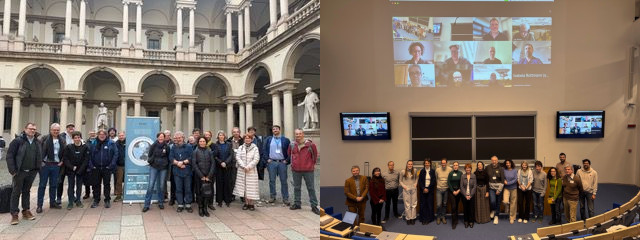
Research Infrastructures Forum — The representatives of the various research infrastructures involved in ACME met in Milan (Italy), hosted by the Istituto Lombardo, in mid-January. The meeting was an opportunity to discuss the technical progress of the project, the provision of transnational and virtual access, synergies, and future collaborations. Members of the ACME Scientific Advisory Board also provided a general overview of the different scientific domains.

WP2 & WP3 meeting — In February, members of WP2 and WP3 got together in GSSI, L'Aquila (Italy), to assess the provision of access to data and expertise, provided and foreseen, as well as to examine possible improvements to further extend the reach of ACME actions.

Recent news

Launch of GWOSC+

A new virtual Access tool, GWOSC+, is now available across multiple platforms. The tool provides simplified and unified access to the official gravitational-wave transient catalog (GWTC) data products. It is designed to support a broad community, from newcomers to multi-messenger and experienced gravitational-wave analysts.

The service has been integrated into several complementary platforms, including ACME platforms such as MMODA, thereby reaching a wide and diverse multi-messenger user base and supporting usage scenarios ranging from graphical interfaces to Jupyter notebooks, Docker images, and command-line execution.

See more info here.

ISAPP summer schools

ISAPP (International Schools on Astroparticle Physics) is pleased to announce two summer schools this year, each providing an introduction to topics in astroparticle physics.

  • In June, the first school will take place at the Institut Pascal of the Paris-Saclay University, focusing on “High-Energy Astrophysics: Sources and Detection”. Participants will study non-thermal sources and radiation processes through lectures and hands-on data analysis sessions.
  • In July, the second school will be held in Munich at the MPP and TUM campuses, centered on “The Low Energy Frontier: Dark Matter and Neutrinos in Theory and Experiment”. This program will include dark matter, neutrinos, and detectors, with lectures, discussions, and interactive sessions and student discussion session.

See more info here.

Cherenkov Astronomy Data School 2026

There will be a one-week school on gamma-ray astronomy organized at the Observatoire de Paris, designed for PhD students/postdocs/researchers eager to learn about gamma-ray astronomy data and the specific challenges of ground-based Cherenkov observations and of high-energy data analysis. This will cover in particular gammapy expertise.

See more info here.

linkedin  youtube 
Unsubscribe   |   Manage your subscription


Funded by the European Union. Views and opinions expressed are however those of the author(s) only and do not necessarily reflect those of the European Union or of the European Research Executive Agency (REA). Neither the European Union nor the granting authority can be held responsible for them. The ACME project has received funding from the European Union’s Horizon Europe Research and innovation programme under Grant Agreement No 101131928.