ACME science cases
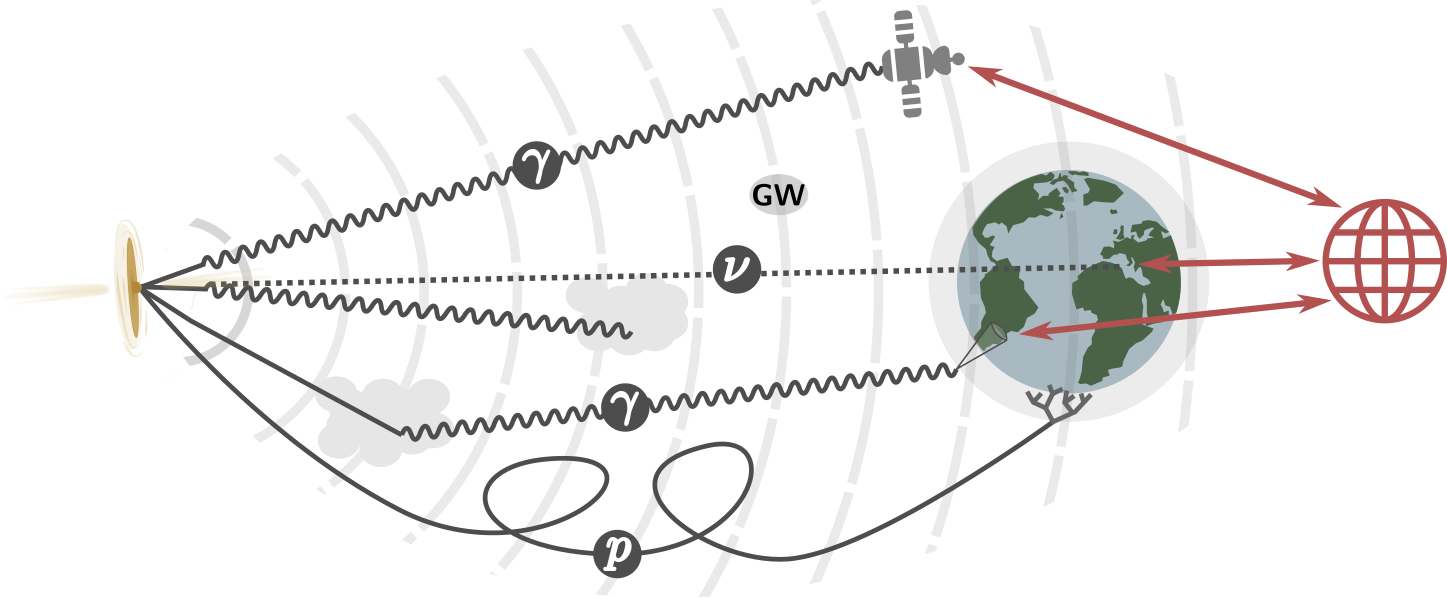
ACME provides access to the infrastructures and the expertise for the broad community of researchers carrying out multi-messenger astronomy. The science topics of ACME are very broad; they cover the study of astrophysical objects or phenomena that may be linked to physical processes responsible for the production of electromagnetic radiation, particles, and/or gravitational waves.
✔ These objects come in a broad range of scales and configurations, a non-exhaustive list being: supermassive black holes (SMBH), blazars, active galactic nuclei, SMBH mergers, intermediate-mass black holes, compact binary mergers, pulsar-wind nebulae, supernovae, kilonovae, novae, gamma-ray bursts, X-ray binaries, pulsars, magnetars, fast radio bursts, tidal disruption events, other transient phenomena. Phenomena include matter in extreme conditions, particle acceleration and propagation in the interstellar medium, and gravitational lensing. Any studies of these objects and phenomena with one or multiple cosmic messengers, both from an observational (detection, imaging, spectrometry, characterisation…) and a phenomenological (modelling, predictions…) point of view, are within the scope of ACME.
✘ Unless a direct link with multi-messenger sources, observations and modelling is made, the following topics are not connected to ACME: early-Universe cosmology (inflation phase, structure formation, Big Bang Nucleosynthesis), studies of dark energy, dark matter, galaxy evolution, stellar birth and evolution, (regular) variable stars, Galactic structure, observation of spacecraft, planetary science, interstellar matter, solar physics, exoplanets.